AP Human Geography Topic 1.1: Introduction to Maps: Mercator, Robinson, Peters, and Choropleth Distortion
Student Packet Step 1: Press play above to watch the 1m 48s classroom video lesson (with English CC captions) while completing Parts 1 through 6 of your Guided Notes packet.
Maps are essential tools for representing spatial information, but every projection introduces trade-offs in accuracy. Reference maps show location, while thematic maps display data patterns. Understanding projection distortion and map types is crucial for interpreting geographic information accurately. Geographers must evaluate the strengths and limitations of each map to avoid misinterpretation.
Essential CED Question: How do different map types and projections influence our understanding of spatial patterns and geographic data?
CED Topic Breakdown & Guided Notes Summary
- Core Map Types and Projections: Maps can be categorized as reference or thematic, each serving different purposes. Reference maps show locations and boundaries, while thematic maps display spatial patterns of specific data. Common projections like Mercator, Robinson, and Peters each introduce unique distortions. Understanding these differences is key to accurate geographic analysis.
- Worked Examples: Distortion and Scale: All projections distort some aspect of the Earth's surface. The Mercator projection exaggerates areas near the poles, while the Peters projection preserves area but distorts shape. Scale of analysis, whether global or local, affects how patterns are interpreted. Recognizing these effects helps avoid misreading spatial data.
- Exam Traps: Misreading Maps and Data: Students often misinterpret map data due to projection distortion or misunderstanding map types. For example, assuming area is always preserved or confusing reference and thematic maps. Careful attention to map legends, scales, and projection types is necessary to avoid these common errors on the AP exam.
Essential Exam Vocabulary & Rubric Terms
- Map Projection: A method for representing the curved surface of the Earth on a flat map, each with unique distortions.
- Reference Map: A map type that emphasizes the location of spatial phenomena, such as countries, cities, or physical features.
- Thematic Map: A map that displays spatial patterns of a specific variable, such as population density or election results.
- Choropleth Map: A thematic map that uses color or shading to represent data values in predefined areas like countries or states.
- Mercator Projection: A cylindrical map projection that preserves direction but distorts area, especially near the poles.
- Robinson Projection: A compromise map projection that minimizes distortion of shape, area, and distance but does not eliminate any.
Visual Anchor Chart & AP Rubric Reference
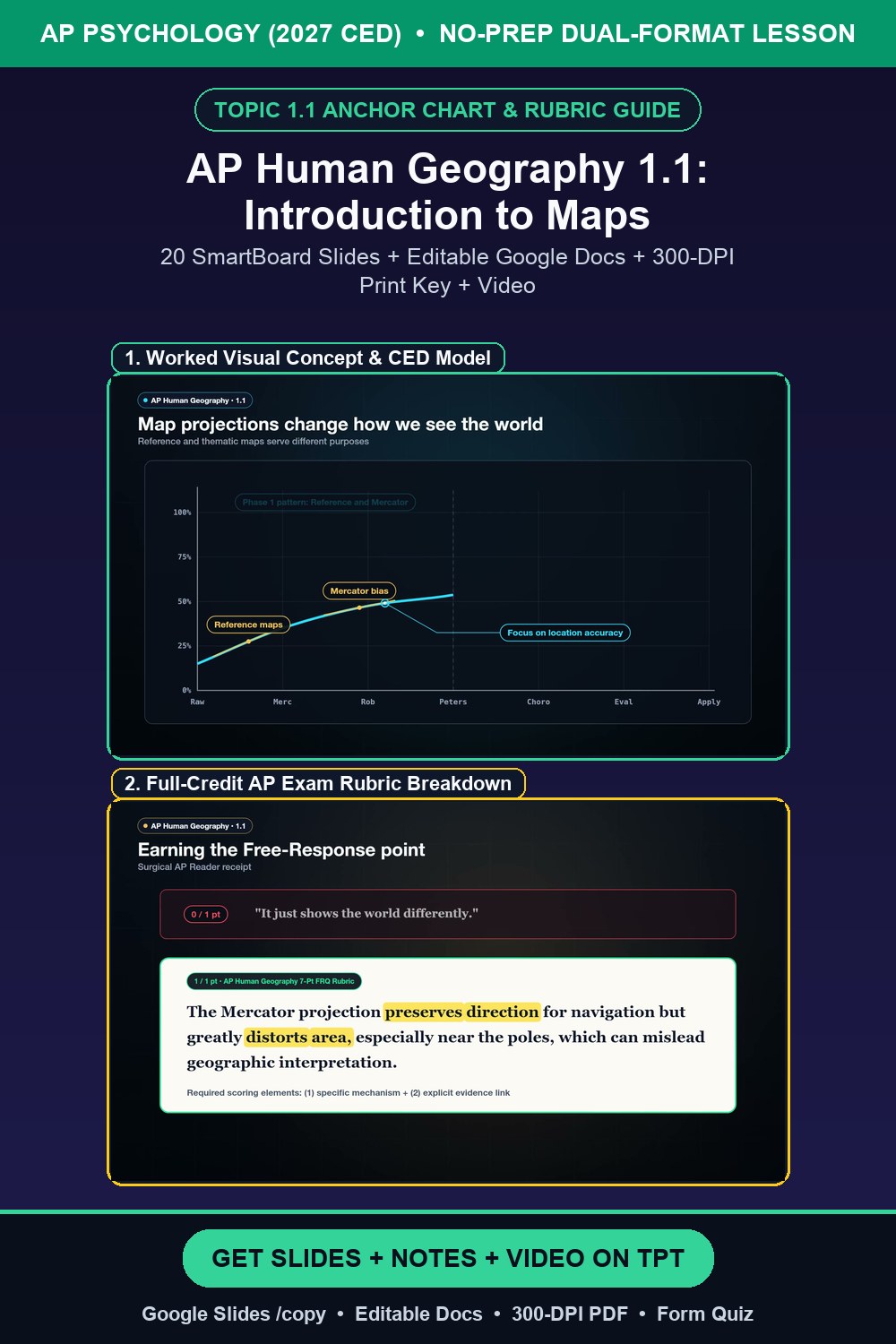
Project or Pin This Topic Anchor Chart
Includes 20 editable widescreen SmartBoard slides (1-click Google Slides /copy + PowerPoint .pptx), scaffolded guided notes, 300-DPI print PDFs, bookended 1080p30 classroom video, and self-grading Google Forms quiz.
4-Way Classroom & Self-Study Upgrade Paths
AP Psychology FULL YEAR GROWING BUNDLE (New 5-Unit CED) | Slides + QTI Bank
Lock in the 35% OFF Full-Curriculum Growing Bundle for $39.98 (#18343064) or the 30% OFF Unit 3 Growing Bundle for $27.60 (#18336125). Every future V3 Dual-Format pack unlocks free in your TpT library.
Companion bundles: Full-Year #18343114 ($39.00) · Unit 3 #18338841 ($42.00)
Complete AP Psych & Precalc Cram + Canvas QTI 1.2 Vault
Immediate ZIP checkout with import-ready Canvas / Schoology QTI 1.2 question banks, 300-DPI cram packets, and annotated FRQ / AAQ / EBQ scoring keys.
AP Psychology Unit 3 Practice Exams ($12.99 Launch Special)
2 full-length timed practice exams (40 blind-verified stimulus MCQs) with distractor diagnostics and step-by-step rubric rationales. 31-day $12.99 Launch Special (code LAUNCH2026_APPSYCH, valid through Dec 15, 2026 via official 97%-share instructor coupon).
Companion course: AP Precalculus Unit 3 Practice Exams ($12.99 Launch)
AP Psychology Unit 3: Development & Learning · Live on Amazon ($16.99 · ASIN B0HRR3H727 · ISBN 9798142642141)
300-DPI 8.5x11 physical Amazon Paperbacks: AP Psychology Unit 3: Development & Learning - Live on Amazon ($16.99, ASIN B0HRR3H727, ISBN 9798142642141), AP Precalculus Unit 3 Exam Prep Workbook - Live on Amazon ($16.99, ASIN B0HRQJLPRZ, ISBN 9798142561688), Corporate L&D AI & SCORM Playbook - Live on Amazon ($24.99, ASIN B0HRQFWFPR, ISBN 9798142559005), Production LLM Evaluation & Multi-Agent Operations - Publishing on Amazon ($24.99, ISBN 9798142670465), and AP Psychology Units 1 & 2: Biological Bases & Cognition ($18.99, 116pp, releasing Nov 22).