AP Psychology Topic 4.7: Emotion: Physiological and Cognitive Appraisal Theories, Facial Feedback, and Affective Science
Student Packet Step 1: Press play above to watch the 1m 45s classroom video lesson (with English CC captions) while completing Parts 1 through 6 of your Guided Notes packet.
Emotion results from a complex interplay between bodily arousal and mental appraisal. Different theories prioritize either the physical response or the cognitive label in the sequence of emotional experience. Modern affective science integrates these views to explain how facial expressions and biological markers influence mood.
Essential CED Question: How do physiological responses and cognitive interpretations interact to produce the subjective experience of emotion?
CED Topic Breakdown & Guided Notes Summary
- Classical Theories of Emotion: Early theories debated the timing of bodily responses and mental awareness. James-Lange focuses on the body first, while Cannon-Bard argues for simultaneity. Schachter-Singer adds a critical cognitive step to the process.
- Cognitive Appraisal and Facial Feedback: Cognitive appraisal determines how we interpret a situation before or during an emotional response. The facial feedback hypothesis suggests a bidirectional link between muscles and mood. These concepts highlight the mind-body loop.
- Affective Science and Exam Traps: Affective science uses empirical data to refine these theories. A common exam trap is confusing the sequence of events in the three main theories. Always identify if the label comes before, during, or after arousal.
Essential Exam Vocabulary & Rubric Terms
- James-Lange Theory: The theory that physiological arousal occurs first, and the emotion is perceived based on that arousal.
- Cannon-Bard Theory: The theory that physiological arousal and emotional experience occur simultaneously and independently.
- Schachter-Singer Two-Factor Theory: The theory that emotion requires both physiological arousal and a cognitive label to identify the feeling.
- Cognitive Appraisal: The process of interpreting a stimulus to determine its emotional significance.
- Facial Feedback Hypothesis: The idea that skeletal muscle facial feedback can trigger or intensify a specific emotion.
- Affective Science: The multidisciplinary study of emotion, including biological, cognitive, and social influences.
Visual Anchor Chart & AP Rubric Reference
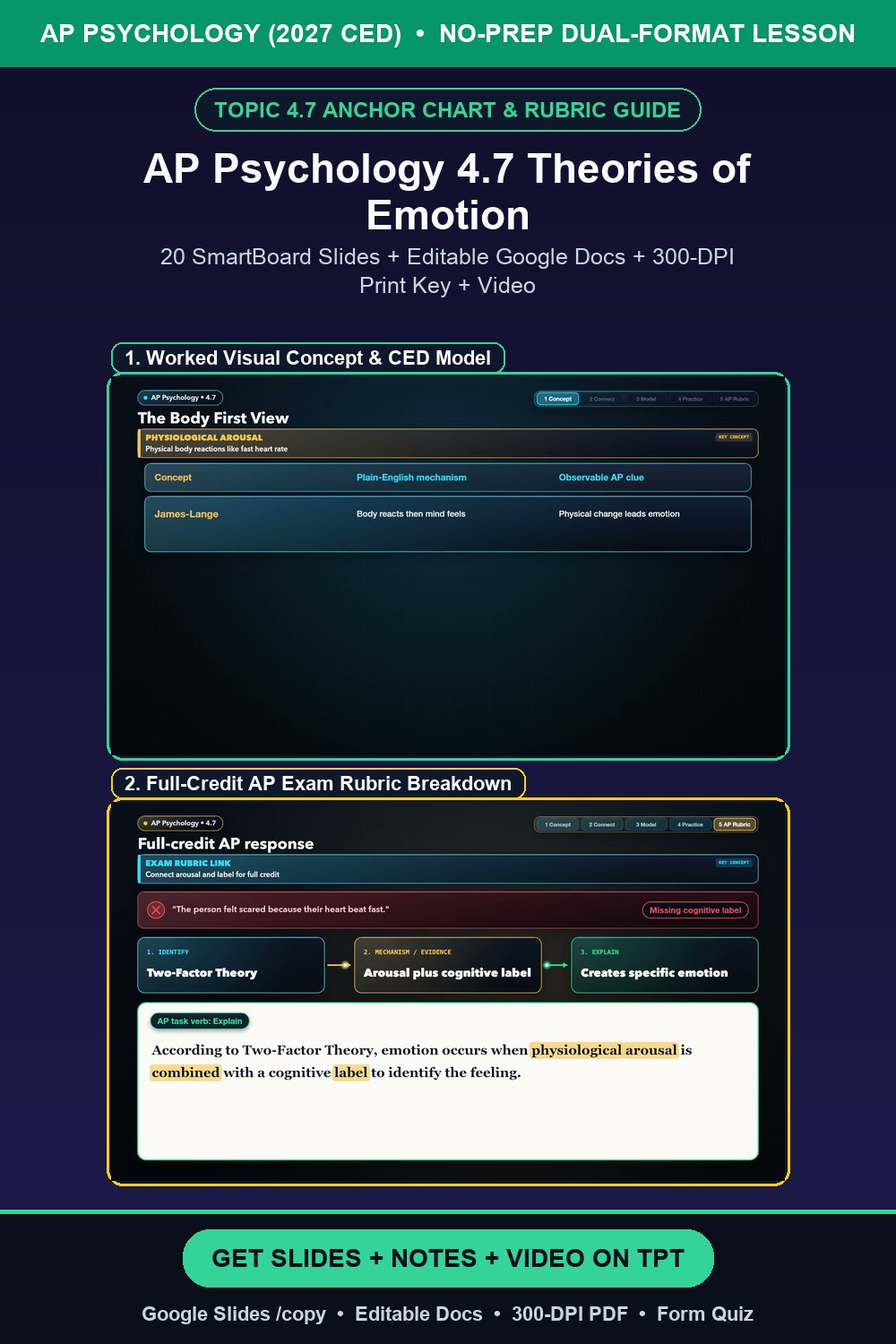
Project or Pin This Topic Anchor Chart
Includes 20 editable widescreen SmartBoard slides (1-click Google Slides /copy + PowerPoint .pptx), scaffolded guided notes, 300-DPI print PDFs, bookended 1080p30 classroom video, and self-grading Google Forms quiz.
4-Way Classroom & Self-Study Upgrade Paths
AP Psychology FULL YEAR GROWING BUNDLE (New 5-Unit CED) | Slides + QTI Bank
Lock in the 35% OFF Full-Curriculum Growing Bundle for $39.98 (#18343064) or the 30% OFF Unit 3 Growing Bundle for $27.60 (#18336125). Every future V3 Dual-Format pack unlocks free in your TpT library.
Companion bundles: Full-Year #18343114 ($39.00) · Unit 3 #18338841 ($42.00)
Complete AP Psych & Precalc Cram + Canvas QTI 1.2 Vault
Immediate ZIP checkout with import-ready Canvas / Schoology QTI 1.2 question banks, 300-DPI cram packets, and annotated FRQ / AAQ / EBQ scoring keys.
AP Psychology Unit 3 Practice Exams ($12.99 Launch Special)
2 full-length timed practice exams (40 blind-verified stimulus MCQs) with distractor diagnostics and step-by-step rubric rationales. 31-day $12.99 Launch Special (code LAUNCH2026_APPSYCH, valid through Dec 15, 2026 via official 97%-share instructor coupon).
Companion course: AP Precalculus Unit 3 Practice Exams ($12.99 Launch)
AP Psychology Unit 3: Development & Learning · Live on Amazon ($16.99 · ASIN B0HRR3H727 · ISBN 9798142642141)
300-DPI 8.5x11 physical Amazon Paperbacks: AP Psychology Unit 3: Development & Learning - Live on Amazon ($16.99, ASIN B0HRR3H727, ISBN 9798142642141), AP Precalculus Unit 3 Exam Prep Workbook - Live on Amazon ($16.99, ASIN B0HRQJLPRZ, ISBN 9798142561688), Corporate L&D AI & SCORM Playbook - Live on Amazon ($24.99, ASIN B0HRQFWFPR, ISBN 9798142559005), Production LLM Evaluation & Multi-Agent Operations - Publishing on Amazon ($24.99, ISBN 9798142670465), and AP Psychology Units 1 & 2: Biological Bases & Cognition ($18.99, 116pp, releasing Nov 22).