AP Psychology Topic 4.5: Social-Cognitive and Trait Theories of Personality: Reciprocal Determinism and Big Five Traits
Student Packet Step 1: Press play above to watch the 1m 51s classroom video lesson (with English CC captions) while completing Parts 1 through 6 of your Guided Notes packet.
Personality is shaped by the interaction of stable traits and dynamic environmental factors. Trait theories focus on enduring characteristics, while social cognitive theories emphasize the reciprocal relationship between behavior and context. Understanding these models allows psychologists to predict behavioral patterns across diverse situations.
Essential CED Question: How do internal traits and external environments interact to shape a stable personality?
CED Topic Breakdown & Guided Notes Summary
- The Big Five Trait Model: The Five Factor Model provides a universal framework for describing personality. These traits exist on a continuum rather than as binary categories. Researchers use these dimensions to predict long term behavioral outcomes.
- Social Cognitive Theory: Albert Bandura emphasized the role of learning and cognition in personality development. He argued that we are not just products of our environment. Instead, we actively shape our experiences through our beliefs.
- Exam Traps and Distinctions: Students often confuse trait stability with behavioral rigidity. It is possible to have a stable trait but adapt behavior to a specific social context. Distinguishing between internal dispositions and learned responses is critical for the AP exam.
Essential Exam Vocabulary & Rubric Terms
- Reciprocal Determinism: The interacting influences of behavior, internal cognition, and environment in an ongoing loop.
- Trait Theory: An approach to personality that identifies stable characteristics that persist across different situations.
- Openness: A Big Five trait reflecting curiosity, imagination, and a preference for novelty and variety.
- Conscientiousness: A Big Five trait characterized by organization, dependability, and a strong drive for achievement.
- Extraversion: A Big Five trait involving sociability, assertiveness, and emotional expressiveness in social settings.
- Agreeableness: A Big Five trait reflecting trust, altruism, kindness, and a cooperative nature toward others.
Visual Anchor Chart & AP Rubric Reference
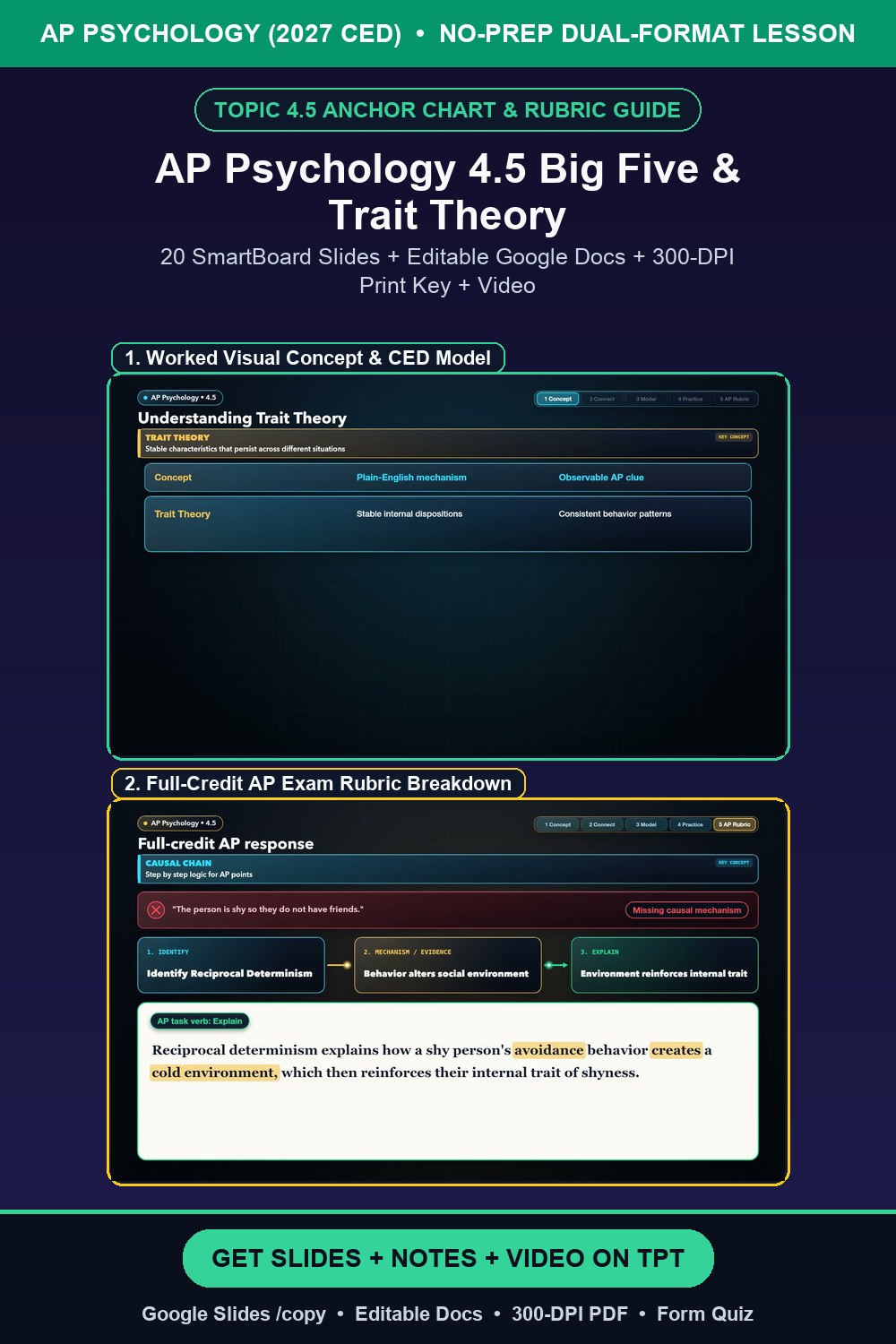
Project or Pin This Topic Anchor Chart
Includes 20 editable widescreen SmartBoard slides (1-click Google Slides /copy + PowerPoint .pptx), scaffolded guided notes, 300-DPI print PDFs, bookended 1080p30 classroom video, and self-grading Google Forms quiz.
4-Way Classroom & Self-Study Upgrade Paths
AP Psychology FULL YEAR GROWING BUNDLE (New 5-Unit CED) | Slides + QTI Bank
Lock in the 35% OFF Full-Curriculum Growing Bundle for $39.98 (#18343064) or the 30% OFF Unit 3 Growing Bundle for $27.60 (#18336125). Every future V3 Dual-Format pack unlocks free in your TpT library.
Companion bundles: Full-Year #18343114 ($39.00) · Unit 3 #18338841 ($42.00)
Complete AP Psych & Precalc Cram + Canvas QTI 1.2 Vault
Immediate ZIP checkout with import-ready Canvas / Schoology QTI 1.2 question banks, 300-DPI cram packets, and annotated FRQ / AAQ / EBQ scoring keys.
AP Psychology Unit 3 Practice Exams ($12.99 Launch Special)
2 full-length timed practice exams (40 blind-verified stimulus MCQs) with distractor diagnostics and step-by-step rubric rationales. 31-day $12.99 Launch Special (code LAUNCH2026_APPSYCH, valid through Dec 15, 2026 via official 97%-share instructor coupon).
Companion course: AP Precalculus Unit 3 Practice Exams ($12.99 Launch)
AP Psychology Unit 3: Development & Learning · Live on Amazon ($16.99 · ASIN B0HRR3H727 · ISBN 9798142642141)
300-DPI 8.5x11 physical Amazon Paperbacks: AP Psychology Unit 3: Development & Learning - Live on Amazon ($16.99, ASIN B0HRR3H727, ISBN 9798142642141), AP Precalculus Unit 3 Exam Prep Workbook - Live on Amazon ($16.99, ASIN B0HRQJLPRZ, ISBN 9798142561688), Corporate L&D AI & SCORM Playbook - Live on Amazon ($24.99, ASIN B0HRQFWFPR, ISBN 9798142559005), Production LLM Evaluation & Multi-Agent Operations - Publishing on Amazon ($24.99, ISBN 9798142670465), and AP Psychology Units 1 & 2: Biological Bases & Cognition ($18.99, 116pp, releasing Nov 22).