AP Psychology Topic 4.4: Psychodynamic and Humanistic Theories of Personality: Defense Mechanisms and Self-Actualization
Student Packet Step 1: Press play above to watch the 1m 53s classroom video lesson (with English CC captions) while completing Parts 1 through 6 of your Guided Notes packet.
This lesson examines the tension between psychodynamic drives and humanistic growth. Students analyze how the ego employs defense mechanisms to manage anxiety. The unit also explores the humanistic pursuit of the ideal self and self actualization.
Essential CED Question: How do unconscious conflicts and the drive for self actualization shape individual personality and behavioral responses?
CED Topic Breakdown & Guided Notes Summary
- The Psychodynamic Structure: Freud proposed a tripartite model of personality. The id, ego, and superego constantly interact to manage internal conflict. This interaction often produces anxiety that requires psychological protection.
- Defense Mechanisms and Anxiety: Defense mechanisms are unconscious distortions of reality. They protect the ego from anxiety caused by conflicting demands. Overreliance on these mechanisms can lead to maladaptive behavior.
- Humanistic Perspectives on Growth: Humanists emphasize free will and the inherent drive toward growth. Rogers and Maslow focused on the conscious experience. They believe the environment must support the individual to reach full potential.
Essential Exam Vocabulary & Rubric Terms
- Id: The primitive part of the personality that operates on the pleasure principle.
- Ego: The rational part of personality that mediates between the id and the superego.
- Superego: The moral component of personality that incorporates societal standards of right and wrong.
- Projection: A defense mechanism where one attributes their own unacceptable impulses to others.
- Reaction Formation: Converting an unacceptable impulse into its opposite behavioral expression.
- Self Actualization: The realization of one's full potential and the desire for personal growth.
Visual Anchor Chart & AP Rubric Reference
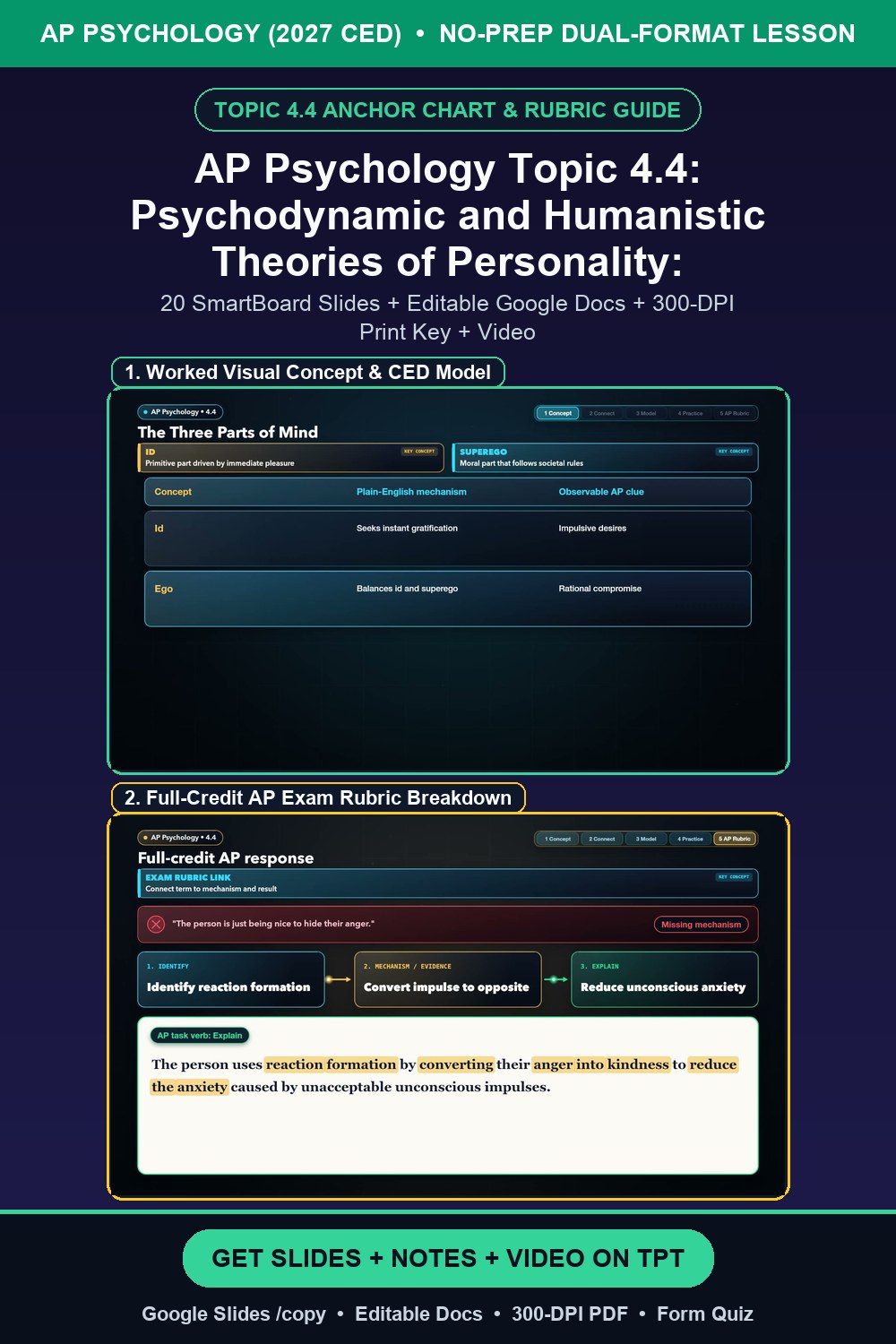
Project or Pin This Topic Anchor Chart
Includes 20 editable widescreen SmartBoard slides (1-click Google Slides /copy + PowerPoint .pptx), scaffolded guided notes, 300-DPI print PDFs, bookended 1080p30 classroom video, and self-grading Google Forms quiz.
4-Way Classroom & Self-Study Upgrade Paths
AP Psychology FULL YEAR GROWING BUNDLE (New 5-Unit CED) | Slides + QTI Bank
Lock in the 35% OFF Full-Curriculum Growing Bundle for $39.98 (#18343064) or the 30% OFF Unit 3 Growing Bundle for $27.60 (#18336125). Every future V3 Dual-Format pack unlocks free in your TpT library.
Companion bundles: Full-Year #18343114 ($39.00) · Unit 3 #18338841 ($42.00)
Complete AP Psych & Precalc Cram + Canvas QTI 1.2 Vault
Immediate ZIP checkout with import-ready Canvas / Schoology QTI 1.2 question banks, 300-DPI cram packets, and annotated FRQ / AAQ / EBQ scoring keys.
AP Psychology Unit 3 Practice Exams ($12.99 Launch Special)
2 full-length timed practice exams (40 blind-verified stimulus MCQs) with distractor diagnostics and step-by-step rubric rationales. 31-day $12.99 Launch Special (code LAUNCH2026_APPSYCH, valid through Dec 15, 2026 via official 97%-share instructor coupon).
Companion course: AP Precalculus Unit 3 Practice Exams ($12.99 Launch)
AP Psychology Unit 3: Development & Learning · Live on Amazon ($16.99 · ASIN B0HRR3H727 · ISBN 9798142642141)
300-DPI 8.5x11 physical Amazon Paperbacks: AP Psychology Unit 3: Development & Learning - Live on Amazon ($16.99, ASIN B0HRR3H727, ISBN 9798142642141), AP Precalculus Unit 3 Exam Prep Workbook - Live on Amazon ($16.99, ASIN B0HRQJLPRZ, ISBN 9798142561688), Corporate L&D AI & SCORM Playbook - Live on Amazon ($24.99, ASIN B0HRQFWFPR, ISBN 9798142559005), Production LLM Evaluation & Multi-Agent Operations - Publishing on Amazon ($24.99, ISBN 9798142670465), and AP Psychology Units 1 & 2: Biological Bases & Cognition ($18.99, 116pp, releasing Nov 22).