AP Psychology Topic 4.3: Psychology of Social Situations: Conformity, Obedience, Groupthink, and Prosocial Behavior
Student Packet Step 1: Press play above to watch the 1m 49s classroom video lesson (with English CC captions) while completing Parts 1 through 6 of your Guided Notes packet.
This lesson examines the powerful influence of the social environment on human action. Students analyze the mechanisms of conformity, obedience, and groupthink. The unit also explores the psychological drivers of prosocial behavior and the bystander effect.
Essential CED Question: How do social situations and group dynamics influence individual behavior and decision making?
CED Topic Breakdown & Guided Notes Summary
- Conformity and Obedience: Conformity involves adjusting behavior to match a group, while obedience involves following orders. Asch demonstrated normative influence through line tests. Milgram showed that authority figures can compel people to act against their morals.
- Group Dynamics and Decision Making: Groups can enhance or hinder individual performance. Groupthink occurs when the desire for harmony overrides realistic appraisal. Deindividuation reduces accountability in crowds.
- Prosocial Behavior and the Bystander Effect: Prosocial behavior is driven by empathy and social norms. The bystander effect occurs due to diffusion of responsibility. Helping increases when the victim is perceived as needing help urgently.
Essential Exam Vocabulary & Rubric Terms
- Conformity: The act of matching attitudes, beliefs, and behaviors to group norms.
- Obedience: A form of social influence where an individual yields to a direct order from authority.
- Groupthink: The tendency for group members to prioritize consensus over critical evaluation of alternatives.
- Prosocial Behavior: Social behavior that benefits other people or society as a whole.
- Bystander Effect: The phenomenon where individuals are less likely to offer help when others are present.
- Normative Influence: Conforming to be liked or accepted by a group.
Visual Anchor Chart & AP Rubric Reference
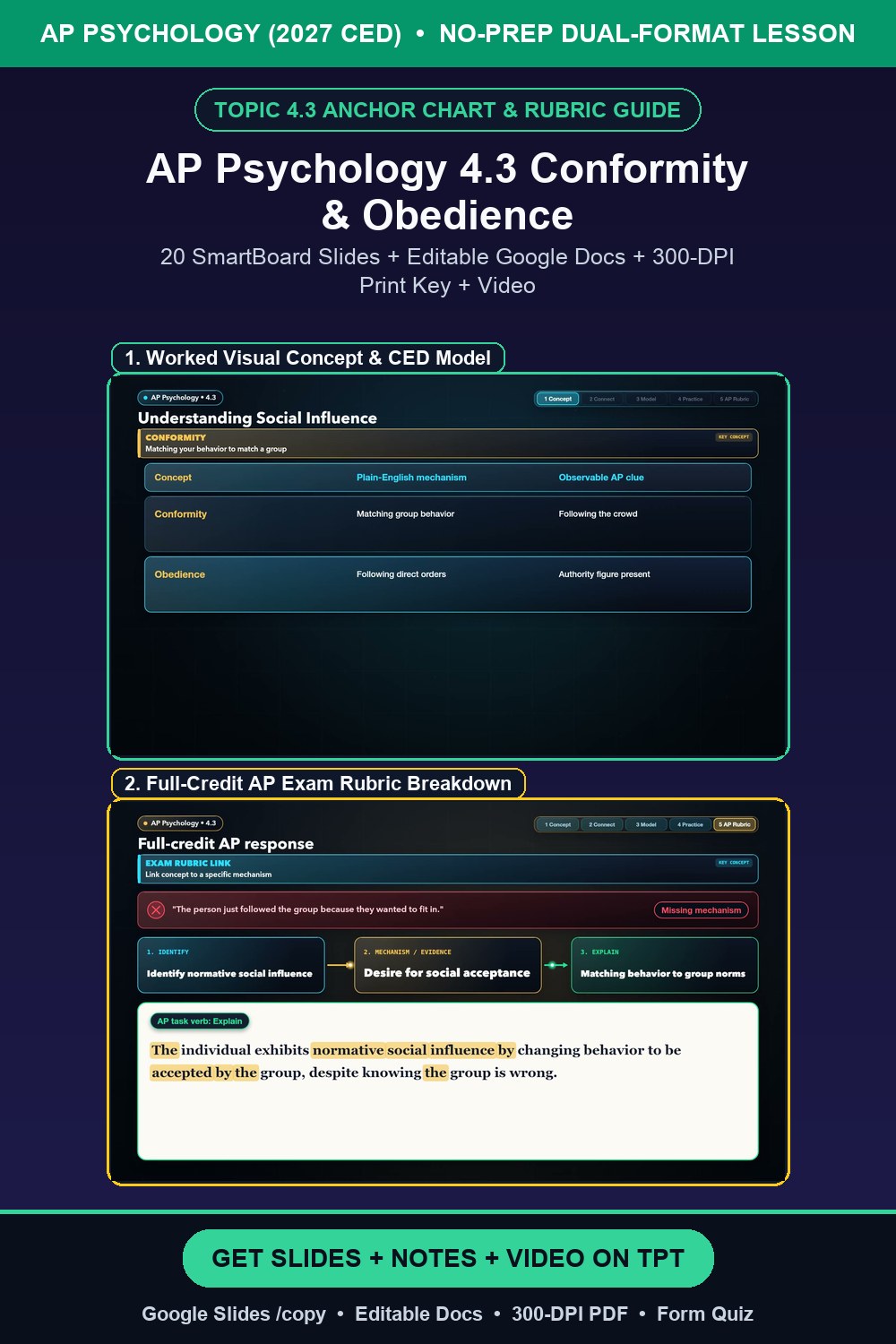
Project or Pin This Topic Anchor Chart
Includes 20 editable widescreen SmartBoard slides (1-click Google Slides /copy + PowerPoint .pptx), scaffolded guided notes, 300-DPI print PDFs, bookended 1080p30 classroom video, and self-grading Google Forms quiz.
4-Way Classroom & Self-Study Upgrade Paths
AP Psychology FULL YEAR GROWING BUNDLE (New 5-Unit CED) | Slides + QTI Bank
Lock in the 35% OFF Full-Curriculum Growing Bundle for $39.98 (#18343064) or the 30% OFF Unit 3 Growing Bundle for $27.60 (#18336125). Every future V3 Dual-Format pack unlocks free in your TpT library.
Companion bundles: Full-Year #18343114 ($39.00) · Unit 3 #18338841 ($42.00)
Complete AP Psych & Precalc Cram + Canvas QTI 1.2 Vault
Immediate ZIP checkout with import-ready Canvas / Schoology QTI 1.2 question banks, 300-DPI cram packets, and annotated FRQ / AAQ / EBQ scoring keys.
AP Psychology Unit 3 Practice Exams ($12.99 Launch Special)
2 full-length timed practice exams (40 blind-verified stimulus MCQs) with distractor diagnostics and step-by-step rubric rationales. 31-day $12.99 Launch Special (code LAUNCH2026_APPSYCH, valid through Dec 15, 2026 via official 97%-share instructor coupon).
Companion course: AP Precalculus Unit 3 Practice Exams ($12.99 Launch)
AP Psychology Unit 3: Development & Learning · Live on Amazon ($16.99 · ASIN B0HRR3H727 · ISBN 9798142642141)
300-DPI 8.5x11 physical Amazon Paperbacks: AP Psychology Unit 3: Development & Learning - Live on Amazon ($16.99, ASIN B0HRR3H727, ISBN 9798142642141), AP Precalculus Unit 3 Exam Prep Workbook - Live on Amazon ($16.99, ASIN B0HRQJLPRZ, ISBN 9798142561688), Corporate L&D AI & SCORM Playbook - Live on Amazon ($24.99, ASIN B0HRQFWFPR, ISBN 9798142559005), Production LLM Evaluation & Multi-Agent Operations - Publishing on Amazon ($24.99, ISBN 9798142670465), and AP Psychology Units 1 & 2: Biological Bases & Cognition ($18.99, 116pp, releasing Nov 22).