AP Psychology Topic 4.1: Attribution Theory and Person Perception: Fundamental Attribution Error and Locus of Control
Student Packet Step 1: Press play above to watch the 1m 39s classroom video lesson (with English CC captions) while completing Parts 1 through 6 of your Guided Notes packet.
This lesson examines the cognitive processes used to interpret social behavior. Students will analyze the tendency to overemphasize internal traits over external situations. The unit also explores how beliefs about personal control influence behavioral outcomes.
Essential CED Question: How do we explain the causes of behavior in ourselves and others?
CED Topic Breakdown & Guided Notes Summary
- The Mechanics of Attribution: Attribution is the process of explaining why events or behaviors occur. We generally categorize these explanations as either internal or external. These judgments often occur automatically and influence our social interactions.
- Cognitive Biases in Perception: Human judgment is rarely objective. We frequently fall into patterns of error when judging others versus ourselves. These biases protect our self esteem and reduce cognitive load.
- Locus of Control and Agency: Locus of control refers to where an individual perceives the source of their success or failure. This belief system significantly impacts motivation and mental health. It determines how much agency a person feels in their life.
Essential Exam Vocabulary & Rubric Terms
- Attribution Theory: The framework for understanding how people explain the causes of behavior.
- Fundamental Attribution Error: The tendency to overestimate personality traits and underestimate situational factors when judging others.
- Internal Locus of Control: The belief that one's own efforts and decisions determine life outcomes.
- External Locus of Control: The belief that outside forces like fate or luck determine life outcomes.
- Dispositional Attribution: Assigning the cause of a behavior to internal characteristics or personality traits.
- Situational Attribution: Assigning the cause of a behavior to external environmental factors.
Visual Anchor Chart & AP Rubric Reference
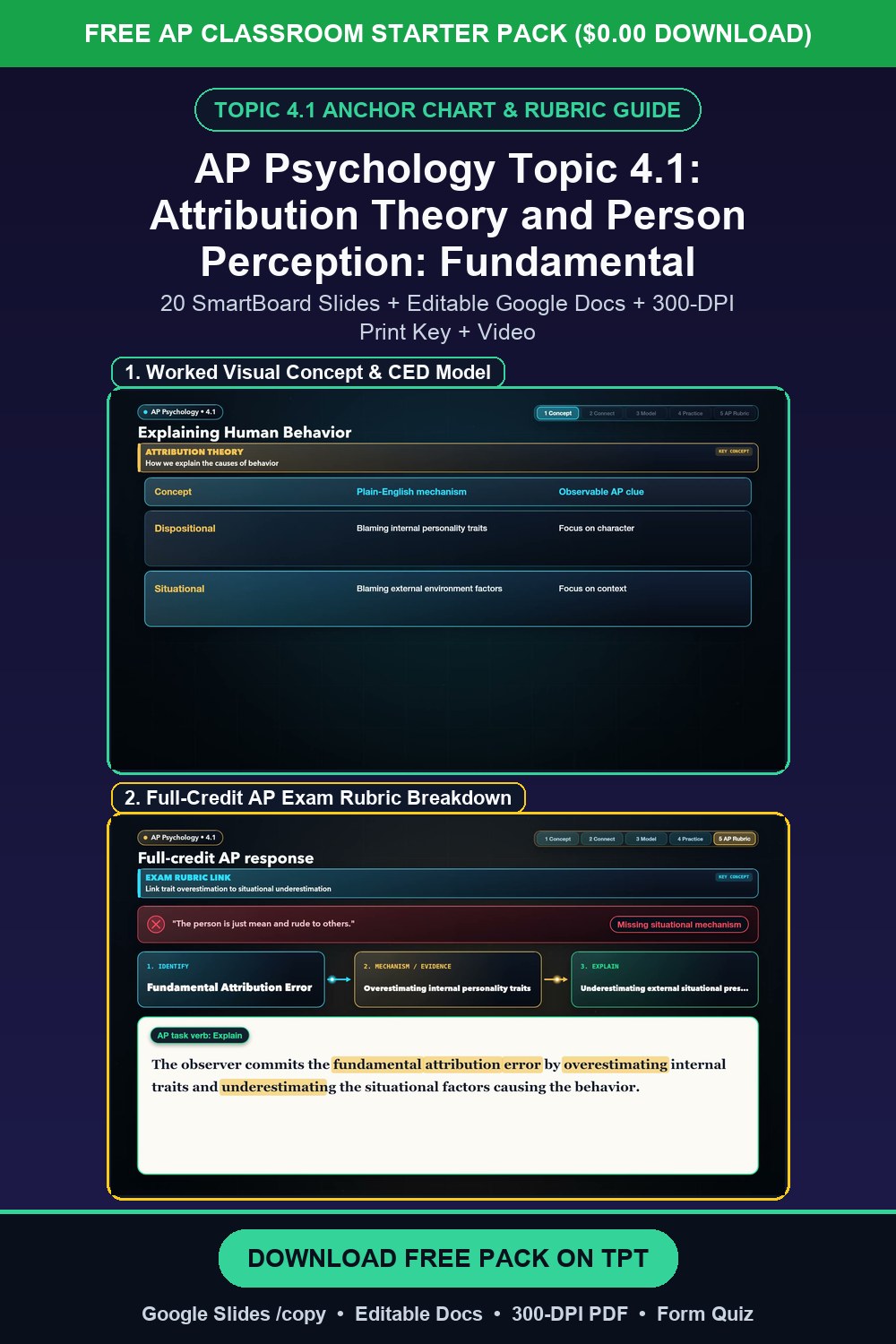
Project or Pin This Topic Anchor Chart
Includes 20 editable widescreen SmartBoard slides (1-click Google Slides /copy + PowerPoint .pptx), scaffolded guided notes, 300-DPI print PDFs, bookended 1080p30 classroom video, and self-grading Google Forms quiz.
4-Way Classroom & Self-Study Upgrade Paths
AP Psychology FULL YEAR GROWING BUNDLE (New 5-Unit CED) | Slides + QTI Bank
Lock in the 35% OFF Full-Curriculum Growing Bundle for $39.98 (#18343064) or the 30% OFF Unit 3 Growing Bundle for $27.60 (#18336125). Every future V3 Dual-Format pack unlocks free in your TpT library.
Companion bundles: Full-Year #18343114 ($39.00) · Unit 3 #18338841 ($42.00)
Complete AP Psych & Precalc Cram + Canvas QTI 1.2 Vault
Immediate ZIP checkout with import-ready Canvas / Schoology QTI 1.2 question banks, 300-DPI cram packets, and annotated FRQ / AAQ / EBQ scoring keys.
AP Psychology Unit 3 Practice Exams ($12.99 Launch Special)
2 full-length timed practice exams (40 blind-verified stimulus MCQs) with distractor diagnostics and step-by-step rubric rationales. 31-day $12.99 Launch Special (code LAUNCH2026_APPSYCH, valid through Dec 15, 2026 via official 97%-share instructor coupon).
Companion course: AP Precalculus Unit 3 Practice Exams ($12.99 Launch)
AP Psychology Unit 3: Development & Learning · Live on Amazon ($16.99 · ASIN B0HRR3H727 · ISBN 9798142642141)
300-DPI 8.5x11 physical Amazon Paperbacks: AP Psychology Unit 3: Development & Learning - Live on Amazon ($16.99, ASIN B0HRR3H727, ISBN 9798142642141), AP Precalculus Unit 3 Exam Prep Workbook - Live on Amazon ($16.99, ASIN B0HRQJLPRZ, ISBN 9798142561688), Corporate L&D AI & SCORM Playbook - Live on Amazon ($24.99, ASIN B0HRQFWFPR, ISBN 9798142559005), Production LLM Evaluation & Multi-Agent Operations - Publishing on Amazon ($24.99, ISBN 9798142670465), and AP Psychology Units 1 & 2: Biological Bases & Cognition ($18.99, 116pp, releasing Nov 22).