AP Precalculus Topic 2.8: Inverse Functions: One-to-One Invertibility, Domain Restrictions, and Composite Identity Checks
Student Packet Step 1: Press play above to watch the 1m 50s classroom video lesson (with English CC captions) while completing Parts 1 through 6 of your Guided Notes packet.
This lesson examines the criteria for a function to possess an inverse. Students analyze one to one properties and the necessity of domain restrictions for non monotonic functions. The focus remains on verifying inverses through composite identity checks.
Essential CED Question: How do domain restrictions and one to one properties enable the existence of inverse functions?
CED Topic Breakdown & Guided Notes Summary
- One-to-One Invertibility: A function is invertible if and only if it is one to one. This means no two distinct inputs produce the same output. We use the horizontal line test to verify this graphically.
- Domain Restrictions: Many common functions are not one to one over their natural domains. By restricting the domain to an interval where the function is monotonic, we create an invertible branch.
- Composite Identity Checks: Algebraic verification of an inverse requires composition. If the composition of two functions results in the identity function x, they are inverses of each other.
Essential Exam Vocabulary & Rubric Terms
- One-to-One: A function where every output is paired with exactly one unique input.
- Inverse Function: A function that reverses the operation of the original function by swapping inputs and outputs.
- Domain Restriction: Limiting the input values of a function to make it one to one.
- Composite Identity: The property where f(f inverse(x)) = x and f inverse(f(x)) = x.
- Horizontal Line Test: A graphical method to determine if a function is one to one.
- Monotonic: A function that is entirely non increasing or entirely non decreasing.
Visual Anchor Chart & AP Rubric Reference
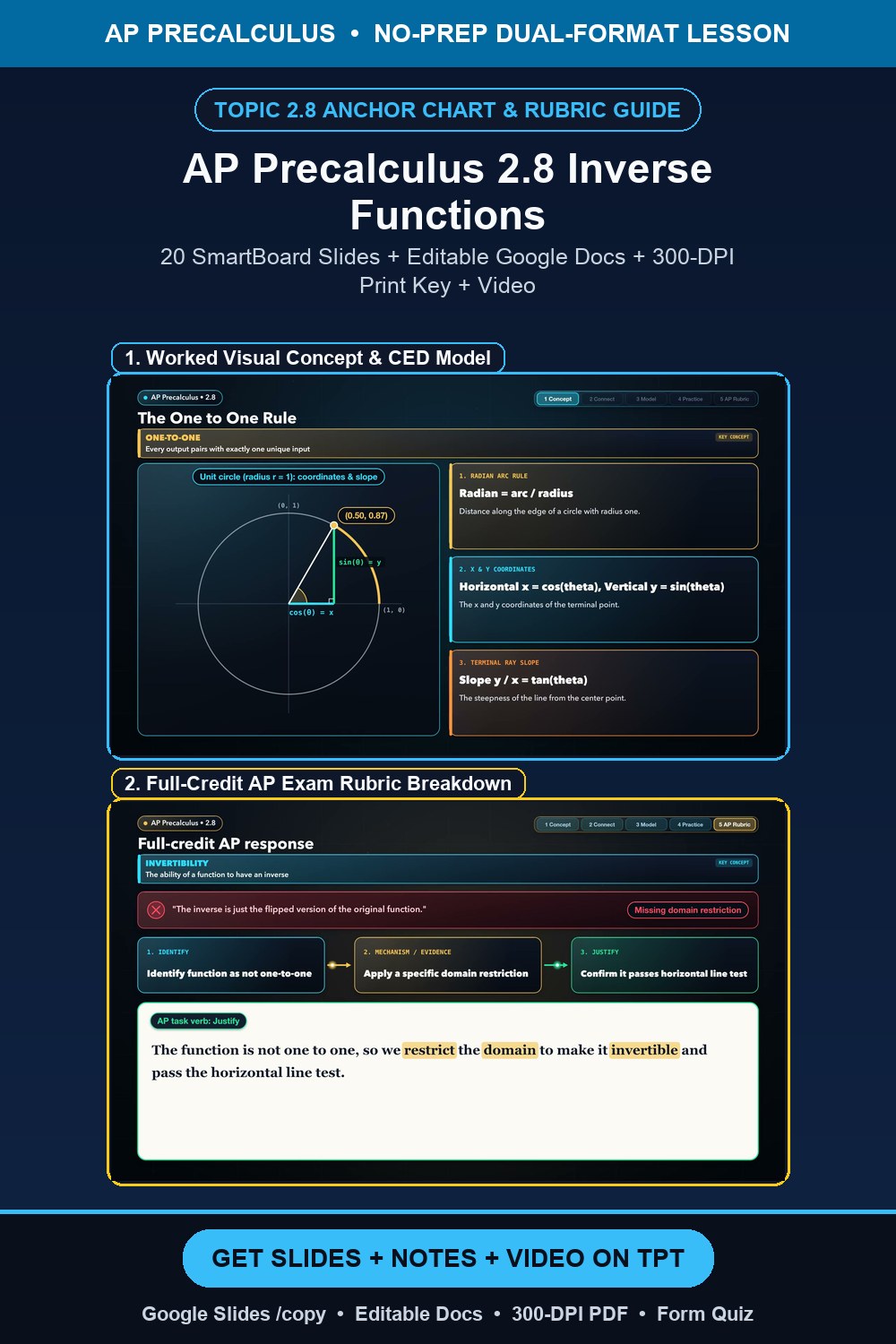
Project or Pin This Topic Anchor Chart
Includes 20 editable widescreen SmartBoard slides (1-click Google Slides /copy + PowerPoint .pptx), scaffolded guided notes, 300-DPI print PDFs, bookended 1080p30 classroom video, and self-grading Google Forms quiz.
4-Way Classroom & Self-Study Upgrade Paths
AP Precalculus FULL CURRICULUM GROWING BUNDLE | Google Slides + Canvas QTI
Lock in the 35% OFF Full-Curriculum Growing Bundle for $39.00 (#18343114) or the 30% OFF Unit 3 Growing Bundle for $42.00 (#18338841). Every future V3 Dual-Format pack unlocks free in your TpT library.
Companion bundles: Full-Year #18343064 ($39.98) · Unit 3 #18336125 ($27.60)
Complete AP Psych & Precalc Cram + Canvas QTI 1.2 Vault
Immediate ZIP checkout with import-ready Canvas / Schoology QTI 1.2 question banks, 300-DPI cram packets, and annotated FRQ / AAQ / EBQ scoring keys.
AP Precalculus Unit 3 Practice Exams ($12.99 Launch Special)
2 full-length timed practice exams (40 blind-verified stimulus MCQs) with distractor diagnostics and step-by-step rubric rationales. 31-day $12.99 Launch Special (code LAUNCH2026_PRECALC, valid through Dec 15, 2026 via official 97%-share instructor coupon).
Companion course: AP Psychology Unit 3 Practice Exams ($12.99 Launch)
AP Precalculus Unit 3 Exam Prep Workbook · Live on Amazon ($16.99 · ASIN B0HRQJLPRZ · ISBN 9798142561688)
300-DPI 8.5x11 physical Amazon Paperbacks: AP Psychology Unit 3: Development & Learning - Live on Amazon ($16.99, ASIN B0HRR3H727, ISBN 9798142642141), AP Precalculus Unit 3 Exam Prep Workbook - Live on Amazon ($16.99, ASIN B0HRQJLPRZ, ISBN 9798142561688), Corporate L&D AI & SCORM Playbook - Live on Amazon ($24.99, ASIN B0HRQFWFPR, ISBN 9798142559005), Production LLM Evaluation & Multi-Agent Operations - Publishing on Amazon ($24.99, ISBN 9798142670465), and AP Psychology Units 1 & 2: Biological Bases & Cognition ($18.99, 116pp, releasing Nov 22).