AP Precalculus Topic 2.6: Competing Function Model Validation: Residual Plot Analysis and Linear vs. Exponential Fit
Student Packet Step 1: Press play above to watch the 1m 43s classroom video lesson (with English CC captions) while completing Parts 1 through 6 of your Guided Notes packet.
Students evaluate the fit of linear and exponential functions using quantitative evidence. They analyze residual plots to identify systematic patterns that suggest a model is inappropriate. The focus is on using equal-interval differences and ratios to validate the most accurate mathematical representation.
Essential CED Question: How can residual plots and rate of change patterns distinguish between linear and exponential models?
CED Topic Breakdown & Guided Notes Summary
- Quantitative Model Validation: Validation begins with analyzing tabular data for specific growth patterns. Linear models are identified by constant first differences. Exponential models are identified by constant ratios between successive outputs.
- Residual Analysis Techniques: Residuals measure the vertical distance from the data point to the regression line. A plot of these values reveals if the model misses a trend. Randomness in the plot confirms a good fit.
- Linear vs. Exponential Decision Matrix: Choosing the correct model requires comparing both tabular evidence and residual plots. If first differences are constant and residuals are random, choose linear. If ratios are constant and residuals are random, choose exponential.
Essential Exam Vocabulary & Rubric Terms
- Residual: The difference between the observed value and the value predicted by a mathematical model.
- Residual Plot: A scatter plot of the residuals on the vertical axis and the independent variable on the horizontal axis.
- Linear Fit: A model where the output changes by a constant additive amount for every equal change in input.
- Exponential Fit: A model where the output changes by a constant multiplicative factor for every equal change in input.
- Constant Difference: The result of subtracting consecutive y-values in a table with equal x-intervals for a linear function.
- Constant Ratio: The result of dividing consecutive y-values in a table with equal x-intervals for an exponential function.
Visual Anchor Chart & AP Rubric Reference
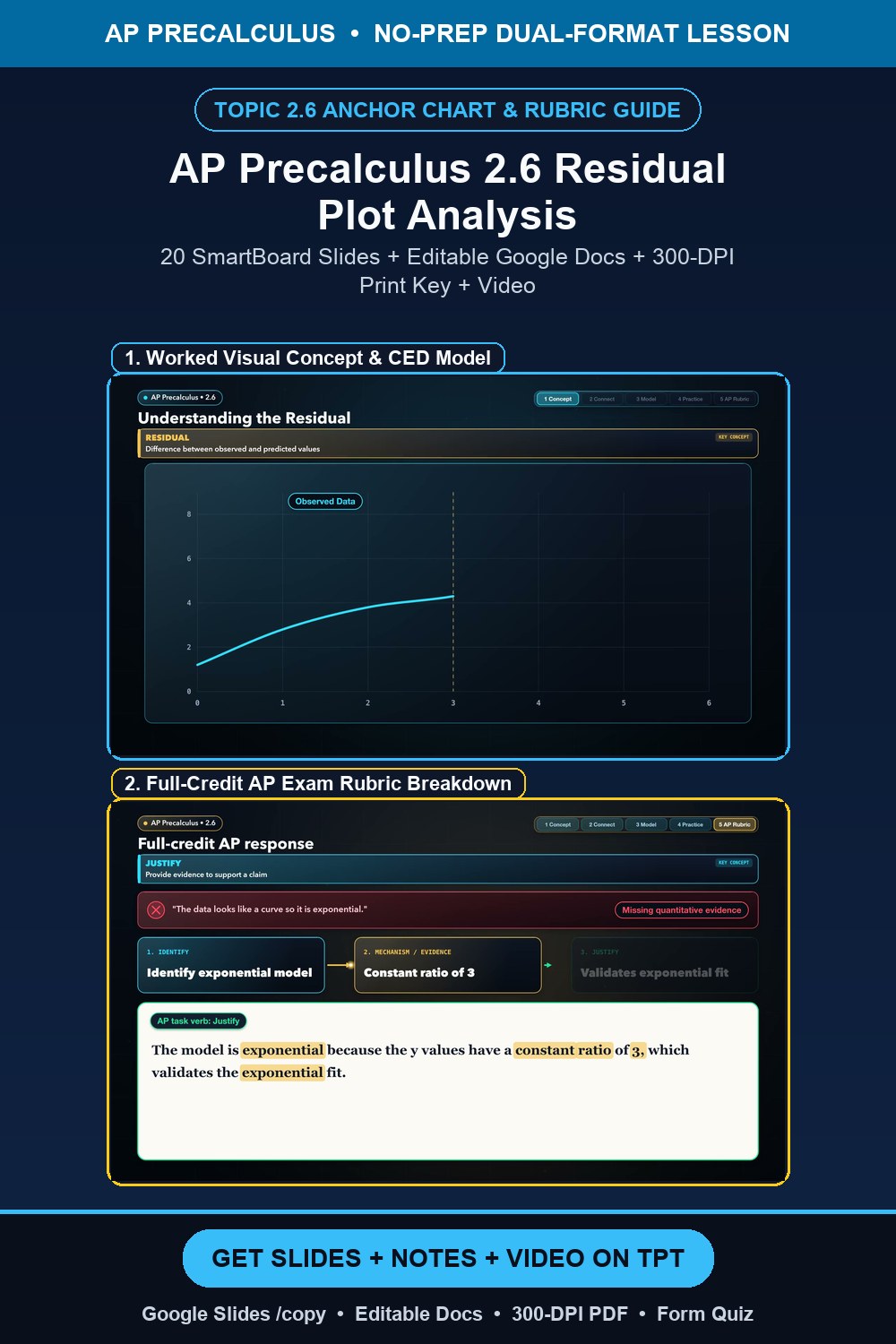
Project or Pin This Topic Anchor Chart
Includes 20 editable widescreen SmartBoard slides (1-click Google Slides /copy + PowerPoint .pptx), scaffolded guided notes, 300-DPI print PDFs, bookended 1080p30 classroom video, and self-grading Google Forms quiz.
4-Way Classroom & Self-Study Upgrade Paths
AP Precalculus FULL CURRICULUM GROWING BUNDLE | Google Slides + Canvas QTI
Lock in the 35% OFF Full-Curriculum Growing Bundle for $39.00 (#18343114) or the 30% OFF Unit 3 Growing Bundle for $42.00 (#18338841). Every future V3 Dual-Format pack unlocks free in your TpT library.
Companion bundles: Full-Year #18343064 ($39.98) · Unit 3 #18336125 ($27.60)
Complete AP Psych & Precalc Cram + Canvas QTI 1.2 Vault
Immediate ZIP checkout with import-ready Canvas / Schoology QTI 1.2 question banks, 300-DPI cram packets, and annotated FRQ / AAQ / EBQ scoring keys.
AP Precalculus Unit 3 Practice Exams ($12.99 Launch Special)
2 full-length timed practice exams (40 blind-verified stimulus MCQs) with distractor diagnostics and step-by-step rubric rationales. 31-day $12.99 Launch Special (code LAUNCH2026_PRECALC, valid through Dec 15, 2026 via official 97%-share instructor coupon).
Companion course: AP Psychology Unit 3 Practice Exams ($12.99 Launch)
AP Precalculus Unit 3 Exam Prep Workbook · Live on Amazon ($16.99 · ASIN B0HRQJLPRZ · ISBN 9798142561688)
300-DPI 8.5x11 physical Amazon Paperbacks: AP Psychology Unit 3: Development & Learning - Live on Amazon ($16.99, ASIN B0HRR3H727, ISBN 9798142642141), AP Precalculus Unit 3 Exam Prep Workbook - Live on Amazon ($16.99, ASIN B0HRQJLPRZ, ISBN 9798142561688), Corporate L&D AI & SCORM Playbook - Live on Amazon ($24.99, ASIN B0HRQFWFPR, ISBN 9798142559005), Production LLM Evaluation & Multi-Agent Operations - Publishing on Amazon ($24.99, ISBN 9798142670465), and AP Psychology Units 1 & 2: Biological Bases & Cognition ($18.99, 116pp, releasing Nov 22).