AP Precalculus Topic 2.3: Exponential Functions: Growth, Decay, Monotonicity, Concavity, and Limit End Behavior
Student Packet Step 1: Press play above to watch the 1m 57s classroom video lesson (with English CC captions) while completing Parts 1 through 6 of your Guided Notes packet.
Exponential functions are characterized by a constant ratio of change over equal intervals. This lesson focuses on the relationship between the base and the resulting monotonicity and concavity. Students will analyze limit end behavior to identify horizontal asymptotes.
Essential CED Question: How do the growth rates and end behaviors of exponential functions differ from linear and polynomial models?
CED Topic Breakdown & Guided Notes Summary
- Monotonicity and the Base: The behavior of f(x) = ab^x is primarily governed by the base b. If b > 1, the function is strictly increasing. If 0 < b < 1, the function is strictly decreasing.
- Concavity and Rate of Change: Concavity describes the curvature of the graph. Exponential functions do not have inflection points. They are always concave up if the leading coefficient a is positive.
- Limit End Behavior: End behavior describes the limits as x approaches infinity or negative infinity. This identifies the horizontal asymptote of the function.
Essential Exam Vocabulary & Rubric Terms
- Monotonicity: The property of a function being entirely non-increasing or non-decreasing on a given interval.
- Concavity: The direction in which a curve bends, determined by whether the rate of change is increasing or decreasing.
- Horizontal Asymptote: A horizontal line that the graph of a function approaches as the input tends toward infinity or negative infinity.
- Limit End Behavior: The value a function approaches as the independent variable increases or decreases without bound.
- Constant Ratio: The fixed multiplier between successive output values for equal increments of the input.
- Exponential Growth: A function where the output increases at an increasing rate as the input increases.
Visual Anchor Chart & AP Rubric Reference
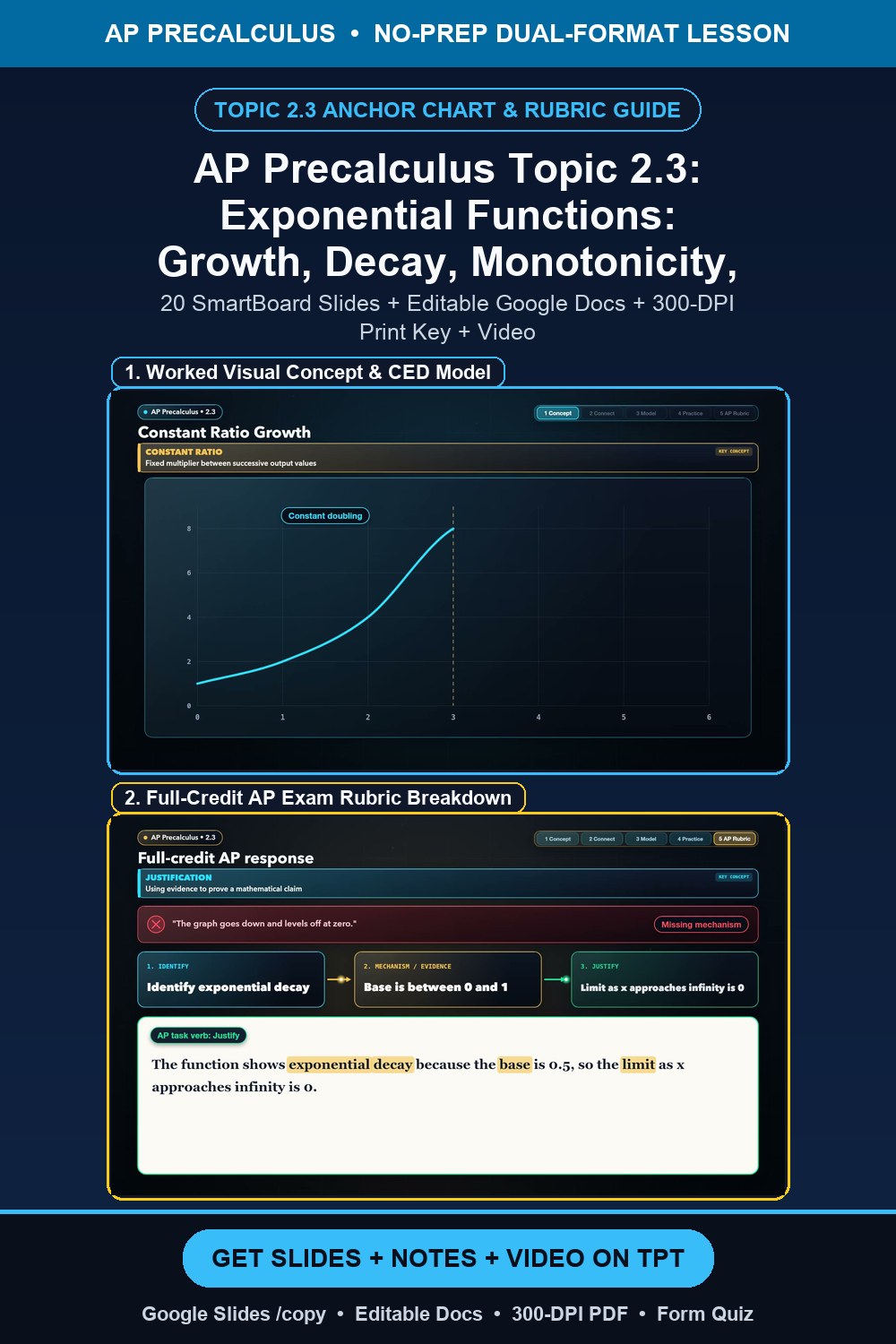
Project or Pin This Topic Anchor Chart
Includes 20 editable widescreen SmartBoard slides (1-click Google Slides /copy + PowerPoint .pptx), scaffolded guided notes, 300-DPI print PDFs, bookended 1080p30 classroom video, and self-grading Google Forms quiz.
4-Way Classroom & Self-Study Upgrade Paths
AP Precalculus FULL CURRICULUM GROWING BUNDLE | Google Slides + Canvas QTI
Lock in the 35% OFF Full-Curriculum Growing Bundle for $39.00 (#18343114) or the 30% OFF Unit 3 Growing Bundle for $42.00 (#18338841). Every future V3 Dual-Format pack unlocks free in your TpT library.
Companion bundles: Full-Year #18343064 ($39.98) · Unit 3 #18336125 ($27.60)
Complete AP Psych & Precalc Cram + Canvas QTI 1.2 Vault
Immediate ZIP checkout with import-ready Canvas / Schoology QTI 1.2 question banks, 300-DPI cram packets, and annotated FRQ / AAQ / EBQ scoring keys.
AP Precalculus Unit 3 Practice Exams ($12.99 Launch Special)
2 full-length timed practice exams (40 blind-verified stimulus MCQs) with distractor diagnostics and step-by-step rubric rationales. 31-day $12.99 Launch Special (code LAUNCH2026_PRECALC, valid through Dec 15, 2026 via official 97%-share instructor coupon).
Companion course: AP Psychology Unit 3 Practice Exams ($12.99 Launch)
AP Precalculus Unit 3 Exam Prep Workbook · Live on Amazon ($16.99 · ASIN B0HRQJLPRZ · ISBN 9798142561688)
300-DPI 8.5x11 physical Amazon Paperbacks: AP Psychology Unit 3: Development & Learning - Live on Amazon ($16.99, ASIN B0HRR3H727, ISBN 9798142642141), AP Precalculus Unit 3 Exam Prep Workbook - Live on Amazon ($16.99, ASIN B0HRQJLPRZ, ISBN 9798142561688), Corporate L&D AI & SCORM Playbook - Live on Amazon ($24.99, ASIN B0HRQFWFPR, ISBN 9798142559005), Production LLM Evaluation & Multi-Agent Operations - Publishing on Amazon ($24.99, ISBN 9798142670465), and AP Psychology Units 1 & 2: Biological Bases & Cognition ($18.99, 116pp, releasing Nov 22).