AP Precalculus Topic 2.2: Change in Linear and Exponential Functions: Equal-Length Input Proportional Growth
Student Packet Step 1: Press play above to watch the 1m 50s classroom video lesson (with English CC captions) while completing Parts 1 through 6 of your Guided Notes packet.
Linear functions exhibit a constant rate of change where equal input increments produce equal output differences. Exponential functions exhibit proportional growth where equal input increments produce a constant ratio of output values. Distinguishing these patterns is critical for modeling real world growth and decay scenarios.
Essential CED Question: How do constant additive changes in linear functions contrast with constant multiplicative changes in exponential functions over equal input intervals?
CED Topic Breakdown & Guided Notes Summary
- Linear vs Exponential Patterns: Linear functions add a constant value over equal intervals. Exponential functions multiply by a constant factor over equal intervals. This distinction allows us to identify function types from tables alone.
- Analyzing Average Rates of Change: The average rate of change for linear functions is constant across all intervals. For exponential functions, the average rate of change increases or decreases proportionally to the function value.
- Graphical Behavior and Exam Traps: Linear graphs are straight lines with no concavity. Exponential graphs are curved and maintain a consistent concavity. Students often mistake a fast linear increase for exponential growth.
Essential Exam Vocabulary & Rubric Terms
- Linear Function: A function with a constant rate of change over any equal length input interval.
- Exponential Function: A function where equal length input intervals result in outputs that change by a constant ratio.
- Constant Difference: The fixed amount added to the output of a linear function for each unit increase in input.
- Constant Ratio: The fixed multiplier applied to the output of an exponential function for each unit increase in input.
- Average Rate of Change: The ratio of the change in output to the change in input over a specific interval.
- Proportional Growth: Growth where the increase in output is proportional to the current value of the function.
Visual Anchor Chart & AP Rubric Reference
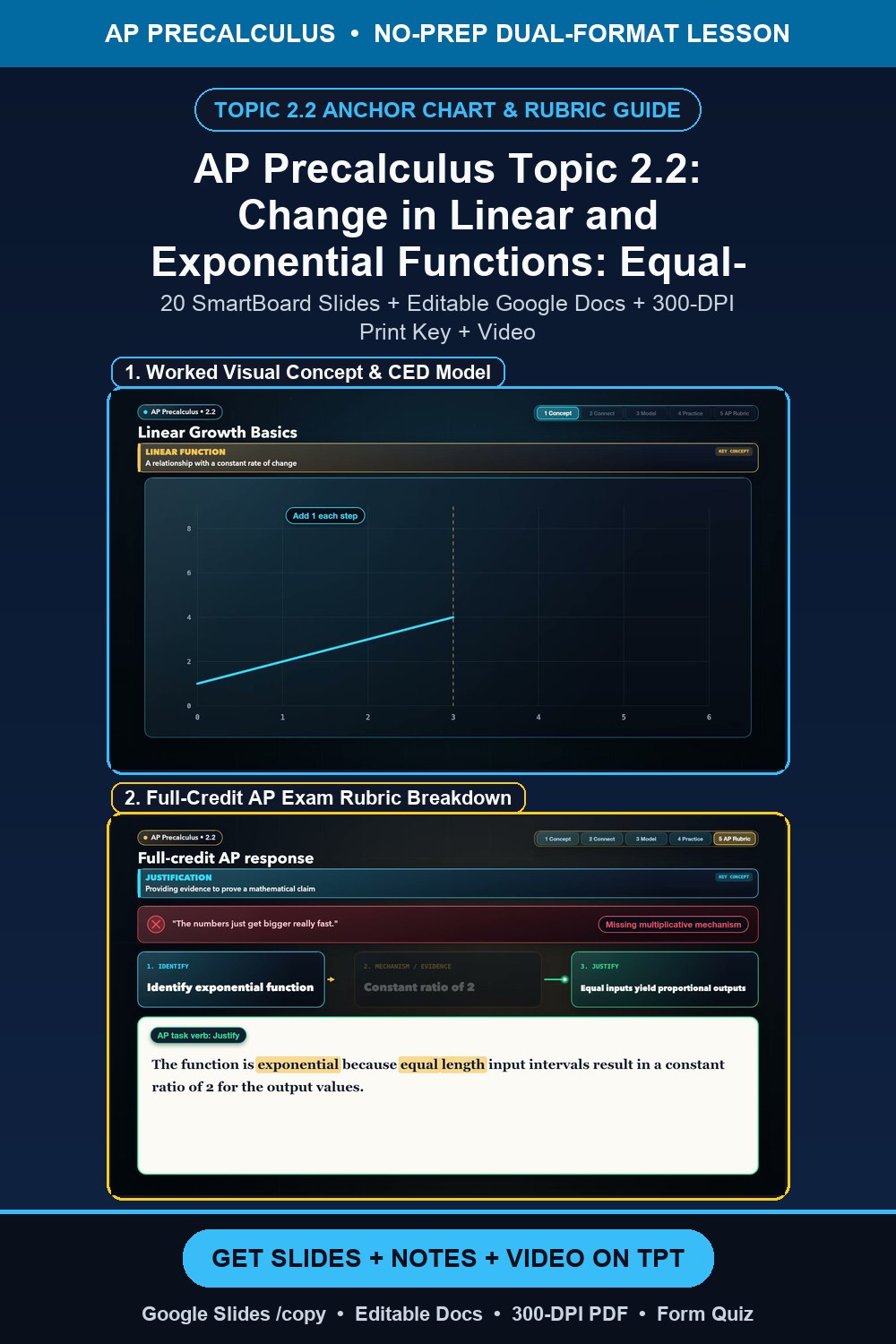
Project or Pin This Topic Anchor Chart
Includes 20 editable widescreen SmartBoard slides (1-click Google Slides /copy + PowerPoint .pptx), scaffolded guided notes, 300-DPI print PDFs, bookended 1080p30 classroom video, and self-grading Google Forms quiz.
4-Way Classroom & Self-Study Upgrade Paths
AP Precalculus FULL CURRICULUM GROWING BUNDLE | Google Slides + Canvas QTI
Lock in the 35% OFF Full-Curriculum Growing Bundle for $39.00 (#18343114) or the 30% OFF Unit 3 Growing Bundle for $42.00 (#18338841). Every future V3 Dual-Format pack unlocks free in your TpT library.
Companion bundles: Full-Year #18343064 ($39.98) · Unit 3 #18336125 ($27.60)
Complete AP Psych & Precalc Cram + Canvas QTI 1.2 Vault
Immediate ZIP checkout with import-ready Canvas / Schoology QTI 1.2 question banks, 300-DPI cram packets, and annotated FRQ / AAQ / EBQ scoring keys.
AP Precalculus Unit 3 Practice Exams ($12.99 Launch Special)
2 full-length timed practice exams (40 blind-verified stimulus MCQs) with distractor diagnostics and step-by-step rubric rationales. 31-day $12.99 Launch Special (code LAUNCH2026_PRECALC, valid through Dec 15, 2026 via official 97%-share instructor coupon).
Companion course: AP Psychology Unit 3 Practice Exams ($12.99 Launch)
AP Precalculus Unit 3 Exam Prep Workbook · Live on Amazon ($16.99 · ASIN B0HRQJLPRZ · ISBN 9798142561688)
300-DPI 8.5x11 physical Amazon Paperbacks: AP Psychology Unit 3: Development & Learning - Live on Amazon ($16.99, ASIN B0HRR3H727, ISBN 9798142642141), AP Precalculus Unit 3 Exam Prep Workbook - Live on Amazon ($16.99, ASIN B0HRQJLPRZ, ISBN 9798142561688), Corporate L&D AI & SCORM Playbook - Live on Amazon ($24.99, ASIN B0HRQFWFPR, ISBN 9798142559005), Production LLM Evaluation & Multi-Agent Operations - Publishing on Amazon ($24.99, ISBN 9798142670465), and AP Psychology Units 1 & 2: Biological Bases & Cognition ($18.99, 116pp, releasing Nov 22).